Blog · 25 March 2026 · 2 min read
What "big affiliate" really means in your GEO
Similarweb visit data shows why partner size labels must follow each market, not fixed linear thresholds.
affiliate marketing · Similarweb · data · geography · Breezy
Ever wondered what “big affiliate” really means in your target GEO? Here is the story data tells.
I keep coming back to one question while building products. Can this be simpler? The goal here is to help users quickly choose the right affiliate size to target, even if they do not know the country-specific traffic landscape.
I started by looking at Similarweb visit data across markets. The pattern is always the same. Traffic is heavily uneven. Most sites are small, a smaller group sits in the middle, and a tiny set of giants captures a disproportionate share of visits.
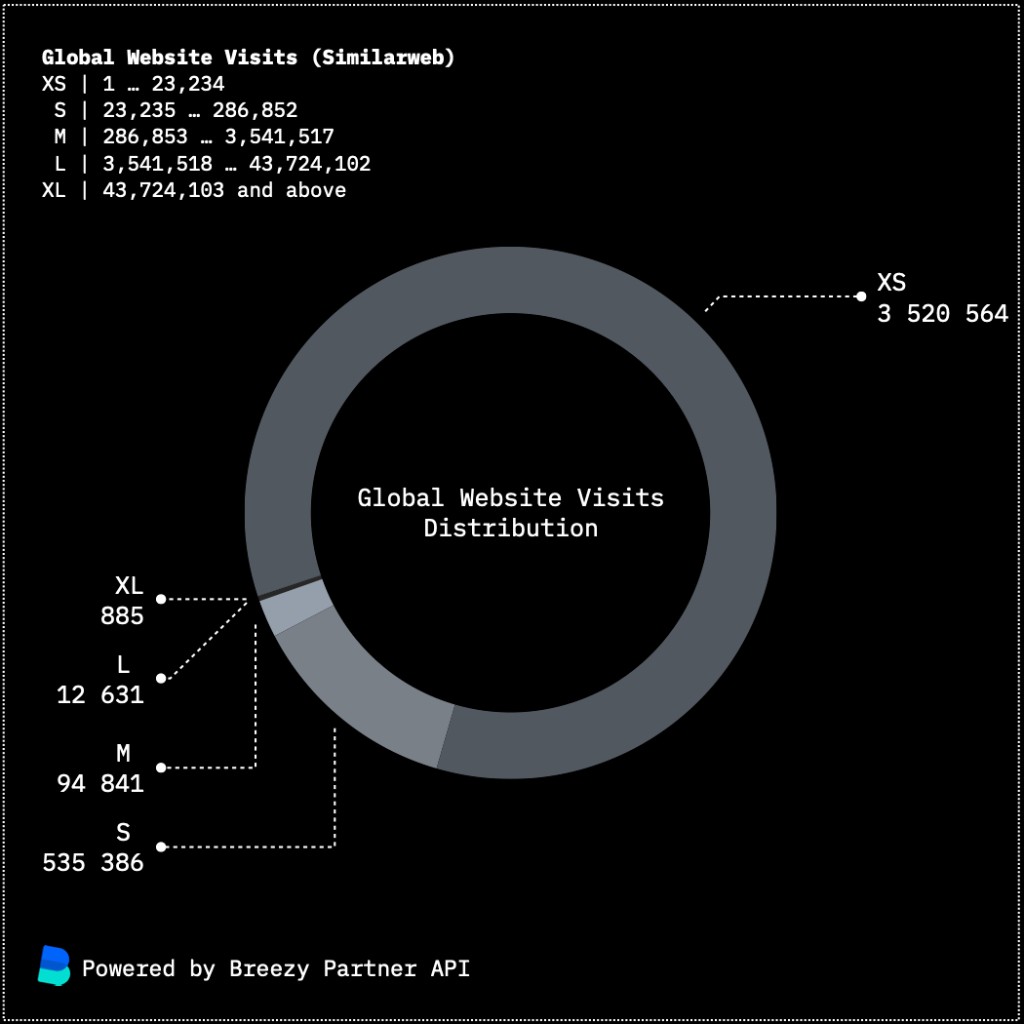
That is exactly why clean round thresholds are misleading. If you split partners into fixed linear ranges, you either collapse the long tail into one oversized bucket or lose the real shape of the top end.
So I took a different approach. We classify partners by size from XS to XL, but the boundaries come from actual market data, not arbitrary numbers. We calculate them in log space between the smallest and largest positive visit values in the same universe, global or country-specific. This keeps each label meaningful even when traffic spans multiple orders of magnitude.
The result is practical. An XS partner globally can still be a solid affiliate in a smaller GEO. “Big” in Brazil is not “big” in Portugal, and not “big” in the US. The label stays intuitive because it reflects relative position inside that market, not someone else’s benchmark.
A couple of important caveats. Many channels do not have reliable visit estimates, so we do not force a size where data is missing. And where data exists, most partners naturally land in the smallest bucket. That is not a flaw. That is how affiliate traffic actually distributes. Large and XL should be rare.
So when someone says, “We only work with big affiliates”, the real question is simple. Big compared to whom, and in which GEO?
Data is still the only honest advisor.